bird ringing chew valley bird ringing course chew valley ringing station

Welcome to the home of CVRS

2012 Ringing Course

News from the Ringing Station

We tried a repeat visit to the orchard at Bishop Sutton, but this year only trapped a small number of birds (unlike last years' 100 or so). The owner had swept up most the fallen apples so there was little to attract the birds in.

Chew Valley Ringing Station

is located in North Somerset just north of the Mendip hills on the southwest shore of Chew Valley Lake and on the A368 road midway between Bath and Weston-super-Mare, between the villages of Bishop Sutton and West Harptree.
Ringing started at Chew Valley Lake in 1963 and the first report was produced by the Mendip Ringing Group covering the years 1962-63. Our ringing area is mainly reed bed with some scrub. Between April and September we normally catch good numbers of Reed Warblers and Sedge Warblers and a varying number of other species such as Blackcap, Chiffchaff and Willow Warbler plus the normal residents which now include Cetti's Warbler. We get a good passage of migrants and there is plenty of chance to see stages of moult. We also attempt to catch hirundines at roost.
2012 ringing course
The 2012 Ringing Course is scheduled for Friday 3rd - Sunday 5th August.
The course aims to provide a 'reed-bed experience' for ringers who normally work in a different habitat. It is also an opportunity for ringers to obtain an appraisal and/ or sponsorship for an upgrade to a 'C' or 'A' permit or an assessment for a training endorsement.
We aim to have a mixed group of six participants on the course plus at least four tutors, a backup ground crew and a BTO rep...

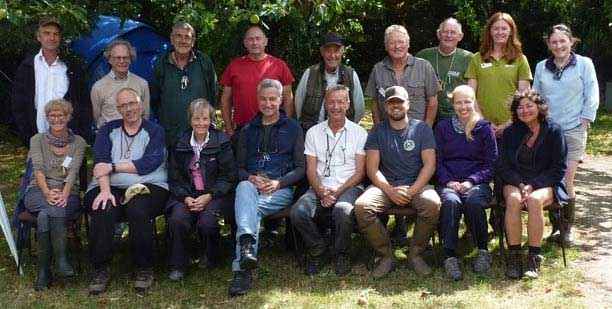
The 2011 Chew Valley Ringing Course

2011 ringing course
Left to right. Front row: course participants: Petra & Oliver MacIver, Ron Hodgson, Jan Riley, Brenda Cook & Viola Ross-Smith. Top row: CVRS members: Mike Rowan, Colin Wearn, Denise Wawman, Bob & Fiona Medland, Mike Bailey, Robin Prytherch, Lee Barber (BTO) Roger Dickey, Steve Mullins & Ed Drewitt.
Most of the course members had arrived by late morning on the Friday and, keeping with tradition, we adjourned to the Blue Bowl Pub in West Harptree for lunch. This gives a very pleasant and informal opportunity for people to get to know each other. The course itself began at 3.00 pm with the official introductions, the giving out of the usual notices concerning Health and Safety (of birds and people), a brief explanation about how the course operates and a net furling demonstration. In the afternoon we operated nets in the area nearest to the ringing station, plus running the Heligoland trap and 3 nets at a feeding station. After supper an unsuccessful attempt was made to catch swallows at roost using a tape lure, so an early night was had by all!
On the Saturday morning ringing began at 6.00 am and a different set of nets was used with the net round taking a circular route. After lunch the 'obligatory' talk about the BTO's purpose built database known as The Integrated Population Monitoring Recorder (IPMR) was given by Lee Barber. This was thought to be very helpful and at just the right level for our 6 trainees. The practical session which followed about calculating primary moult scores and recording wing formulae using dried wings was also received positively. Ringing recommenced at 4.00 pm, followed by supper and a small catch of swallows at the roost.
Ringing on Sunday morning again began at 6.00 am in overcast conditions with the threat of rain later. Here we were given an insight into the new Iphone technology when Colin Wearn announced that a Rain Alert App was telling us that rain was 1.5 kms away! Fortunately we had already begun closing nets and all were safely furled away but the time a steady rain set in.
This year we tried a new regime with the course being split into 3 teams. This worked very well, enabling 2 teams to be ringing with 1 team out on a net round. The team leaving would set the clock at 25 minutes before the bellwhich was the signal for the next team to leave. The course was offered as a reed-bed experience and this we were able to provide, with a steady stream of birds. On a couple of short occasions there were too many birds for the participants to handle comfortably and these were dealt with by our backup crew in a separate workshop. Please see list in the PDF version of this report.
Reed Warblers (right) were, as usual, the most numerous birds caught on the course. We had two Sedge Warbler controls (also right) with this one carrying a Paris ring (image stitched together in Photoshop) being the most exciting.A feature of ringing courses is that the course participants are given a feedback on their advancement towards becoming fully qualified ringers. To this end the tutors have a meeting at the end of the course and agree the comments to be made on the student feedback forms. Whilst this is taking place the course members complete a feedback form about the ringing course! A one to one meeting then follows between the tutors and students to discuss their progress. With the onset of rain bringing the ringing to a halt slightly earlier than planned, there was time for these meetings to take place before lunch.
Votes of thanks and the farewells followed with special thanks to Mike Rowan for issuing rings and transcribing the data from the individual forms used for each bird. To the Backup Crew Roger Dickey, Paul House, Doug Miller and Steve Mullins and for the catering which was once again of a high standard with self-service breakfasts, hot lunches and buffet type suppers, all thanks to Fiona Medland (with help from husband Bob).